

This guide was written for that gap. Whether you are a senior executive hunting for the best strategic foresight books to sharpen your competitive edge, an educator searching for futures thinking books recommended by educators to bring into the classroom, or simply someone who wants to stop being a passenger in their own future — this reading list has been built for you.
You have probably felt it — that creeping, unsettling sense that the world is changing faster than your strategy can keep up. Markets shift overnight. Technologies that barely existed three years ago are now rewriting entire industries. And somewhere in a boardroom right now, a leadership team is scrambling to react to a disruption that a trained futures thinker would have seen coming two years ago.The difference between those who are blindsided and those who are prepared? A foresight literacy that most people have never been taught.
Every book and bundle listed here comes from Metafuture, a globally recognized educational think tank dedicated to Creating Alternative and Preferred Futures. Founded and led by two of the most cited scholars in the discipline, these are not airport-lounge self-help books. These are the texts that researchers reference, that governments commission, and that the world’s leading foresight programs actually teach.
Let’s dig in.
Why Futures Thinking Has Become a Non-Negotiable Leadership Skill
Before we get to the books, it’s worth pausing on a question: why now? Why has foresight — a discipline that has existed since the 1960s — suddenly felt so urgent to so many people?
The honest answer is that the cost of being reactive has never been higher. “Black swan” events, once considered rare exceptions, are now arriving with a regularity that should be alarming. Supply chain collapses, pandemics, geopolitical realignments, AI-driven economic disruption — none of these were truly unpredictable. They were simply not being anticipated by the right people using the right frameworks.
That is precisely what futures literacy books are designed to fix. Futures literacy — the capacity to use imagination to understand and influence the role the future plays in what we see, know, and do — has been described by UNESCO as a 21st-century competency as fundamental as reading and writing. And yet, it is almost entirely absent from the curricula of most schools, business programs, and professional development tracks.
The good news is that it can be learned. And it starts with the right books.
Meet the Authors: Why Sohail Inayatullah and Ivana Milojević Are Names You Need to Know
Before exploring any of these texts, it is worth understanding who created them — because author credibility is not a small thing in a field as contested as futures studies.
Prof. Sohail Inayatullah
Professor Sohail Inayatullah is, by almost any measure, one of the most prolific and influential futures thinkers alive today. He holds UNESCO Chair in Futures Studies and has been a visiting professor at institutions across Asia, Europe, and Australia. His work spans an extraordinary range — from macrohistory and civilizational theory to feminist futures and corporate strategy.
He is best known for developing Causal Layered Analysis (CLA), a methodology that has been applied in contexts ranging from city planning in Singapore to national policy in Finland. His books have been translated into multiple languages and are routinely among the most futures thinking books cited in academic research globally. If you have ever taken a course in strategic foresight at a university level, you have almost certainly encountered his work — whether you knew it or not.
You can explore his complete body of work at Metafuture.org, where decades of research are now available in curated bundles at significantly reduced prices.
Dr. Ivana Milojević
Dr. Ivana Milojević is equally formidable, though she tends to receive somewhat less mainstream attention — which is itself a kind of data point about whose voices get amplified in foresight discourse. Her work sits at the intersection of feminist theory, futures studies, and critical pedagogy, and she has co-authored and co-edited some of the most important texts in the Metafuture collection.
Her contributions make several of these volumes among the most significant futures thinking books written by women authors in the entire discipline. This is not a tokenistic distinction — her theoretical frameworks have genuinely reshaped how practitioners think about alternative and preferred futures, particularly in educational and policy contexts.
Together, Inayatullah and Milojević represent over 60 combined years of original research. When you buy a Metafuture bundle, you are not buying a curated reading list assembled by a marketing team. You are accessing primary scholarship that has shaped the field itself.
The Core Reading: What Every Serious Futures Thinker Needs on Their Shelf
1. The CLA Bundle — For Deep Strategic Thinkers and Policy Professionals
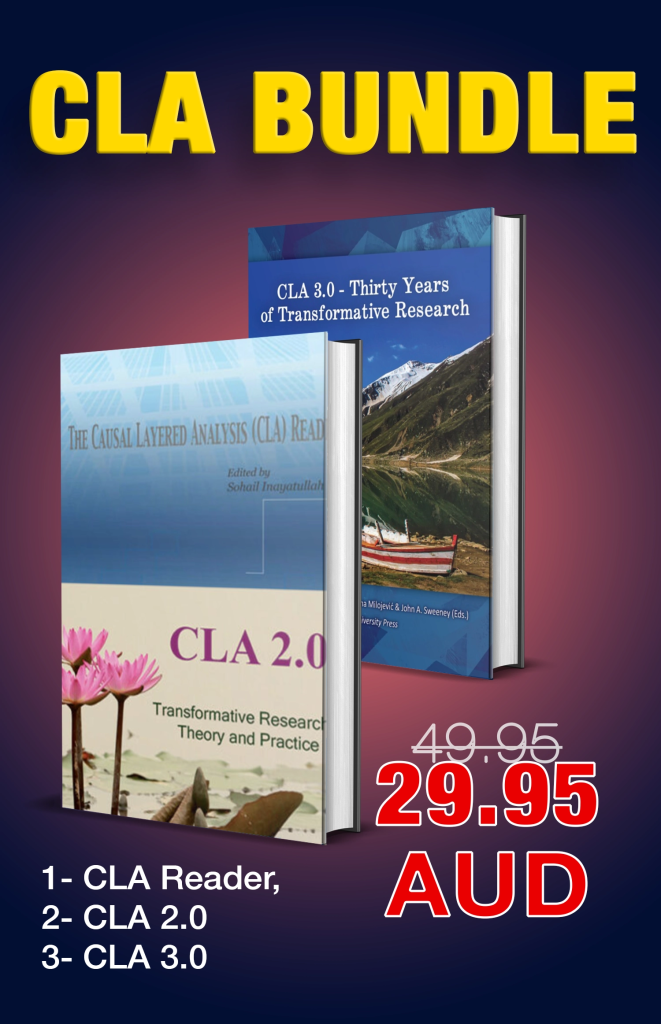
THE CLA Bundle – CLA Reader, CLA 2.0 & CLA 3.0 Currently on Sale: $29.95 (Reduced from $49.95) Available at Metafuture.org
If there is one collection that could be called the backbone of modern futures methodology, it is this one. The CLA Bundle brings together three landmark volumes that trace the evolution of Causal Layered Analysis across thirty years of global application.
The CLA Reader (2004) lays the theoretical groundwork — covering the four levels of reality that CLA practitioners learn to navigate: the surface-level Litany, the Social Causes beneath it, the Worldview that sustains those causes, and finally the deep Myth and Metaphor that make those worldviews feel inevitable. For newcomers, this volume is the essential entry point.
CLA 2.0 (2015) takes those foundations and applies them to some of the most pressing issues of our time — global health, climate futures, water security, and terrorism. It is widely recommended as one of the best futures thinking books for healthcare professionals precisely because the case studies are not abstract: they show how layered analysis changes what questions get asked and, therefore, what solutions become visible.
CLA 3.0 represents the current frontier. Conflict, geopolitics, and the possibility of carbon-negative cities are examined through a lens that challenges not just what we think, but how we think. This volume is particularly valued by futures thinking books for policy makers and futures thinking books for military and defense strategists because it confronts the worldviews that typically go unquestioned in national security discourse.
Taken together, the three volumes function as a complete graduate education in one of the most powerful analytical tools ever developed for navigating uncertainty. They are among the most futures thinking books used in MBA programs worldwide and are consistently cited in PhD-level research.
Best for: Corporate strategists, policy analysts, PhD researchers, military planners, NGO leaders

2. The Futures Thinking and Foresight Bundle — For Practitioners Who Need to Get Things Done
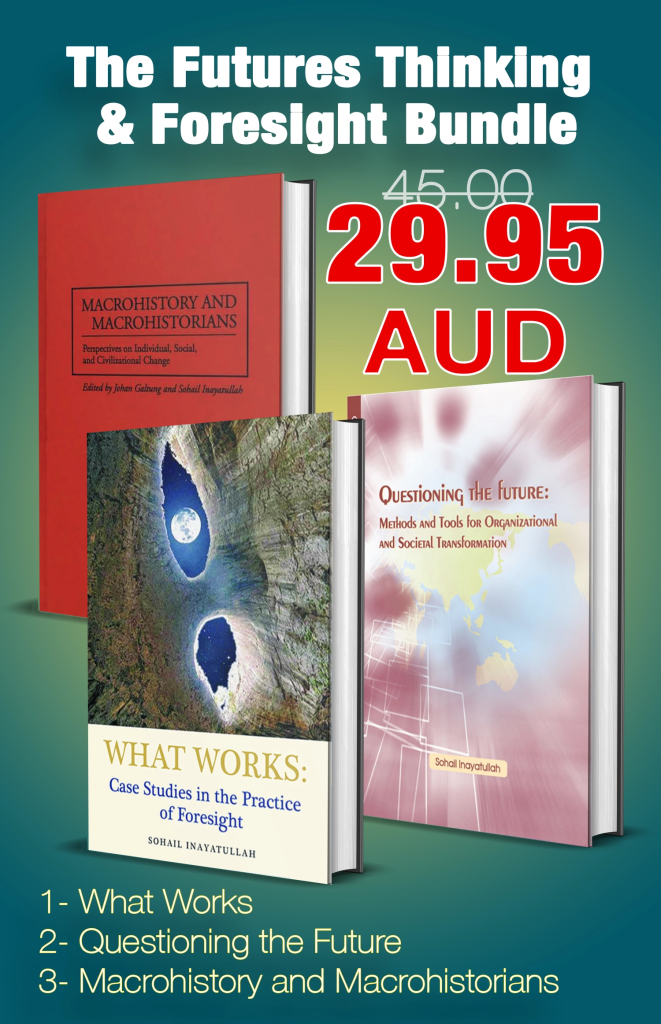
The Futures Thinking and Foresight Bundle Currently on Sale: $29.95 (Reduced from $45.00) Available at Metafuture.org
Theory is necessary. But at some point, someone has to walk into a conference room and actually run the workshop. That is what this bundle was designed for.
Questioning the Future: Methods and Tools for Organizational and Societal Transformation is the standout text here, and it deserves to be recognized as exactly what it is: the definitive answer to the question of how to develop a futures thinking mindset book. It does not just describe futures thinking — it builds it, through structured exercises, provocative questioning frameworks, and scenario planning approaches that have been tested in real organizational settings.
This makes it one of the most valuable futures thinking books with exercises and activities available anywhere, and it is routinely recommended as a core text for futures thinking books for technology teams, futures thinking books for nonprofit leaders, and anyone else who needs to move from abstract understanding to concrete institutional change.
What Works: Case Studies in the Practice of Foresight (2015) complements Questioning the Future perfectly. Where that volume provides the methods, What Works provides the proof — documenting how foresight has been applied in policing, healthcare, digital governance, and community planning. For anyone who has ever needed to make a business case for investing in futures capacity, this is the evidence base you have been looking for.
Macrohistory and Macrohistorians, co-authored by Inayatullah and renowned peace scholar Johan Galtung, rounds out the bundle with a view of civilizational change that dwarfs the quarterly reporting cycle. By studying the rise and fall of empires, economies, and value systems across centuries, readers develop the kind of long-horizon perspective that short-term planning simply cannot produce. This is among the most sophisticated Asian perspectives on futures thinking books in existence, synthesizing Sinic, Islamic, Indic, and Western historical traditions in a way that almost no other single volume attempts.
Best for: Consultants, nonprofit leaders, technology teams, HR executives, educators, social entrepreneurs
3. The Emerging Issues – Weak Signals Bundle — For Those Who Want to See What Others Miss
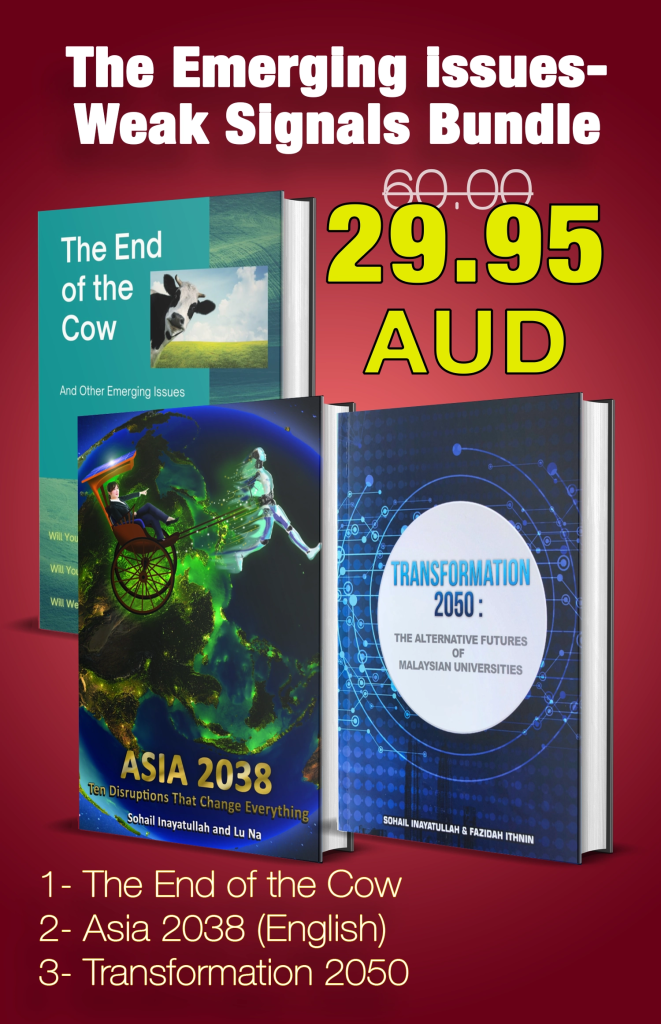
The Emerging Issues-Weak Signals Bundle Currently on Sale: $29.95 (Reduced from $60.00) Available at Metafuture.org
There is a concept in futures studies called “weak signal detection” — the practice of identifying early, often overlooked indicators of coming change before they become undeniable trends. The organizations and leaders who master this skill are the ones who seem to have an almost uncanny ability to be in the right place at the right time. In reality, they were just paying a different kind of attention.
This bundle is the practical guide to developing exactly that attention.
The End of the Cow: And Other Emerging Issues (2022) is arguably the most immediately provocative text in the entire Metafuture catalog. In fewer than 200 pages — making it one of the most accessible short books on futures thinking under 200 pages available — it takes issues that most people have not yet taken seriously and demonstrates, systematically, why they should. Cellular agriculture, the transformation of the family unit, the redesign of cities as anticipatory systems — these are not science fiction premises. They are emerging realities that are being shaped right now, and the organizations paying attention will have an enormous advantage over those that are not.
For futures thinking books for climate change professionals, The End of the Cow is particularly essential. The environmental implications of our food systems are explored with a depth and nuance that goes far beyond what typical sustainability literature offers.
Asia 2038: Ten Disruptions That Change Everything was developed through hundreds of workshops conducted across the Asia-Pacific region and represents one of the most grounded Asian perspectives on futures thinking books available. The ten disruptions identified — ranging from the rising influence of Asian women to post-capitalist economic transitions — are not predictions. They are scenarios constructed through rigorous participatory foresight processes, and they have proven remarkably durable as analytical frameworks since their original publication.
Notably, Asia 2038 is also among the rare examples of futures thinking books translated into multiple languages, with a Mandarin-language edition reflecting its adoption in Chinese-speaking educational and policy contexts.
Transformation 2050 completes the bundle with a strategic foresight blueprint focused on higher education — making it essential reading for futures thinking books for community planners and university administrators navigating the profound disruptions currently reshaping learning institutions globally.
Best for: Community planners, climate professionals, educators, business development strategists, regional policy advisors
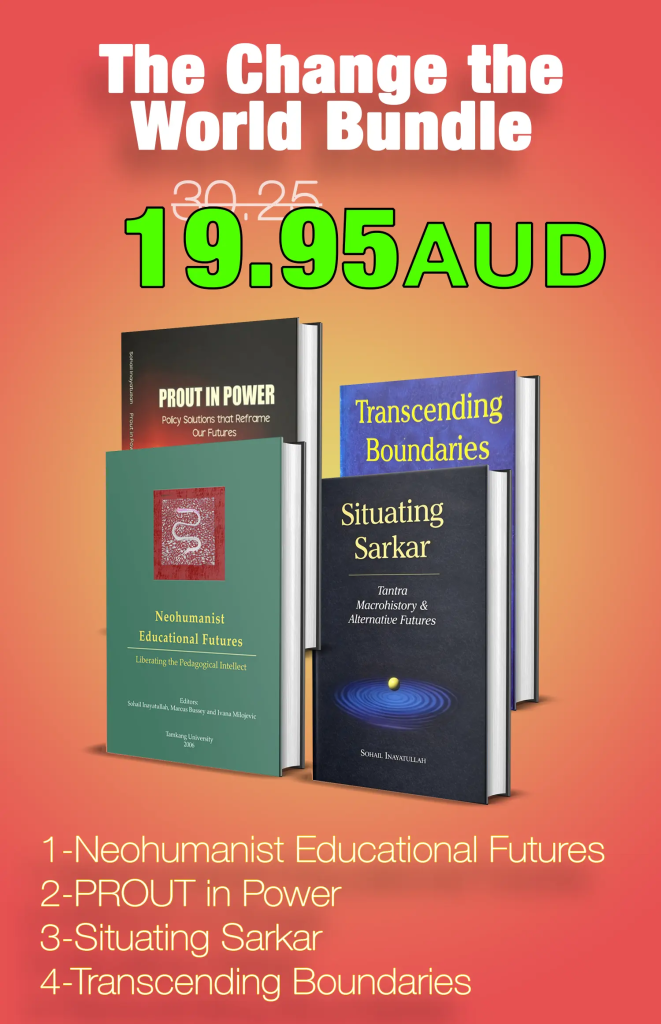
4. The Change the World Bundle — For the Big-Picture Thinkers
The Change the World Bundle Currently on Sale: $19.95 (Original: $30.25) Available at Metafuture.org
At this price point, this bundle is one of the most compelling entry points into the Metafuture ecosystem for readers who are newer to the discipline but want to engage with ideas of genuine intellectual weight. It is also an excellent candidate for futures thinking book club recommendations, particularly for groups that are comfortable with both theoretical and applied dimensions of foresight.
Included in this bundle:
Neohumanist Educational Futures
A powerful reimagining of education beyond test scores and factory models. Rooted in neo-humanism, this work presents a wisdom-centered curriculum focused on human potential, ethics, ecological consciousness, and global citizenship. It integrates Eastern and Western thought to create a paradigm shift in how we educate and live.
Prout in Power: Policy Solutions that Reframe Our Futures
By Sohail Inayatullah
An applied exploration of Prout (Progressive Utilization Theory) — an alternative political economy developed by Prabhat Ranjan Sarkar.
Rather than merely explaining theory, this book imagines Prout in action, addressing higher education, governance, poverty, digital technologies, leadership, and global futures.
Situating Sarkar: Tantra, Macrohistory and Alternative Futures`
A deep intellectual analysis of Sarkar’s macrohistorical theory, comparing his work with major thinkers such as Ibn Khaldun and Hegel, and situating it within modern social theory, governance debates, and futures studies.
Transcending Boundaries
A critical and comparative exploration of power, representation, science, culture, and social cycles — examining how alternative epistemologies can reshape governance and civilizational futures.
Best for: Book clubs, undergraduate students, general readers, new practitioners
5. The Heroine’s Journey Bundle & The Hesitant Feminist’s Guide to the Future
The Heroine’s Journey Bundle Currently on Sale: $9.95 (Reduced from $23.95)
THE HESITANT FEMINIST’S GUIDE TO THE FUTURE (PDF) Available FREE at Metafuture.org — $0.00
It would be a genuine omission to discuss the Metafuture catalog without addressing its commitment to diversity of voice and perspective. The Heroine’s Journey Bundle and The Hesitant Feminist’s Guide to the Future represent some of the most important futures thinking books written by women authors in contemporary foresight literature.
These texts do something that most foresight writing — which has historically skewed toward the perspectives of Western, male, institutional actors — does not do: they challenge the underlying myths and metaphors of the future itself. Who gets to imagine tomorrow? Whose preferred futures get built? What assumptions are baked into our most “objective” models of change?
The Hesitant Feminist’s Guide to the Future is also freely available as a futures thinking book with free PDF download, which reflects Metafuture’s genuine commitment to accessibility. This is scholarship that is designed to be shared, not gatekept.
Best for: Educators, diversity and inclusion practitioners, feminist scholars, anyone who wants to think more critically about whose futures are being built
6. The Future Maker Fiction Series — For Educators and Young Readers
The Future Maker | The Gold Maker | The Peace Maker Available as E-books from $5.95–$7.95 at Metafuture.org
One of the most consistent challenges in futures education is the question of how to engage young people — those for whom the future is not an abstract strategic concern but an approaching reality. These fiction titles provide a narrative entry point that makes foresight concepts viscerally accessible.
As futures thinking books for high school students, they are particularly valuable because they do not condescend. The themes — agency, systems thinking, ethical choice-making, long-term consequence — are serious ones, treated seriously, wrapped in storytelling that actually holds attention.
They are also among the best budget-friendly options for educators on restricted budgets, available well under ten dollars per title.
Best for: High school educators, parents, youth program facilitators, libraries
Matching the Right Book to the Right Reader
One of the most common mistakes in building a foresight library is buying books that are too general for your specific context. Futures thinking is not one-size-fits-all — the frameworks and case studies that resonate with a corporate executive will not necessarily land with a public health administrator or a secondary school teacher. Here is a quick reference guide:
If you are a corporate strategist or MBA student: Start with the Futures Thinking and Foresight Bundle for its practitioner-focus, then add the CLA Bundle for methodological depth. These are the gold standard best futures thinking books for corporate strategists and they’re frequently assigned in executive education programs globally.
If you are in healthcare or public policy: CLA 2.0 was specifically applied to health futures and should be your entry point. Pair it with What Works for its healthcare case studies. Together, these represent the most rigorous futures thinking books for healthcare professionals currently available from a single publisher.
If you are an educator: Questioning the Future is your foundation — it was designed as an instructional tool. Supplement it with The Future Maker fiction series for classroom use and The Hesitant Feminist’s Guide for a free supplementary resource. These are consistently among the most futures thinking books recommended by educators who are working on books on teaching futures thinking in schools.
If you work in climate, sustainability, or environmental policy: The End of the Cow and the full Emerging Issues bundle should come first. These are the most forward-looking futures thinking books for climate change professionals in the catalog — written by people who understand that environmental futures are social, political, and cultural futures too.
If you are in defense, national security, or geopolitics: CLA 3.0’s focus on conflict, geopolitics, and power transitions makes it the most directly relevant text, alongside Macrohistory and Macrohistorians for civilizational context. These are considered essential futures thinking books for military and defense strategists who need to think beyond the next electoral cycle.
If you are building a nonprofit or social enterprise: The Futures Thinking and Foresight Bundle — specifically Questioning the Future — was used extensively in NGO and development contexts. It functions as the best futures thinking books for nonprofit leaders because it was built on participatory, values-driven foresight approaches.
If you are a community planner or urban designer: Asia 2038 and Transformation 2050 within the Emerging Issues bundle were built on community workshop methodologies and speak directly to the challenges of futures thinking books for community planners working at the city and regional level.
A Note on Accessibility: Free Downloads, Budget Options, and Digital Formats
Not everyone has a corporate expense account, and the Metafuture team seems to understand this. Several access points exist for budget-conscious readers:
Free PDF: The Hesitant Feminist’s Guide to the Future is available at absolutely no cost at Metafuture.org. This is perhaps the most generous example of a futures thinking book with free PDF download that the discipline has produced.
Under $10: The fiction titles (The Future Maker, The Gold Maker, The Peace Maker) are available as e-books starting at $5.95 — making them the best examples of used futures thinking books under ten dollars in the catalog in digital form.
Bundle Savings: The three core bundles — CLA, Futures Thinking and Foresight, and Emerging Issues — are all currently priced at $29.95, each representing discounts of 30–50% off their original prices. For anyone building a foresight library from scratch, these bundles represent extraordinary value per page of original research.
Note: For those seeking audiobook futures thinking listening recommendations or titles on Kindle Unlimited, it is worth checking external retailers such as Audible or Amazon, as these formats are not currently listed in the primary Metafuture shop. The core texts, however, are available in PDF and EPUB formats directly from Metafuture.org.
Why Metafuture Is Different From Other Foresight Publishers
There are a lot of futures books published every year. Business school presses produce slick volumes on disruption. Management consultants publish frameworks wrapped in branding. Silicon Valley technologists write breathless manifestos about the coming singularity.
Metafuture.org is doing something categorically different.
The scholarship here is genuinely multi-paradigmatic — meaning it does not privilege any single cultural, ideological, or methodological tradition. The works synthesize Western forecasting methods with Asian philosophical traditions, feminist critiques of linear progress narratives, and indigenous knowledge systems. This is why African futures thinking books and work grounded in Global South perspectives are increasingly part of the Metafuture conversation — and why the catalog continues to expand into new regional and cultural domains.
The authors are not consultants with speaking fees to protect. They are scholars who have spent careers building, testing, critiquing, and refining these methods in the real world. Their books have been adopted by governments, taught in universities, and translated into languages that reflect their genuinely global reach.
That pedigree matters — particularly now, when the marketplace for futures content is crowded with ideas that sound compelling but have never been stress-tested against actual complexity.
The One Question That Changes Everything
Here is a question that Sohail Inayatullah has been known to pose at the start of foresight workshops:
“What is the future that you are unconsciously creating right now?”
It is a discomfiting question, because it implies that the future is not something that happens to us — it is something that is being actively produced by the assumptions, habits, and worldviews that we carry without examining them. The frameworks in these books — CLA, scenario planning, weak signal detection, macrohistorical analysis — are all, in different ways, tools for surfacing those assumptions so that they can be examined, challenged, and, where necessary, transformed.
That is what futures literacy books ultimately do. They do not tell you what the future holds. They change how you see — which changes what you do — which changes what gets built.
And in a world moving this fast, that is not a small thing. That is everything.
Start Building Your Foresight Library Today
All of the books and bundles described in this guide are available directly from Metafuture.org, where current sale prices make this the best moment to invest in your futures capacity. Here is a quick summary of what is currently available:
| 📚 Bundle / Title | 💰 Sale Price | 🏷 Original Price | 🎯 Best For |
|---|---|---|---|
| THE CLA Bundle | $29.95 | $49.95 | Policy, MBA, Military, PhD |
| Futures Thinking & Foresight Bundle | $29.95 | $45.00 | Corporate, Nonprofit, Tech Teams |
| Emerging Issues – Weak Signals Bundle | $29.95 | $60.00 | Climate, Community, Educators |
| Change the World Bundle | $19.95 | $30.25 | Book Clubs, New Practitioners |
| Heroine’s Journey Bundle | $9.95 | $23.95 | Feminist Futures, Educators |
Have questions about which bundle is right for your organization or classroom? Visit Metafuture.org to explore the full catalog, read sample chapters, and connect with the global community of futures practitioners that has grown up around this work.
The future is not a destination that will eventually arrive. It is being shaped — right now, by the quality of thinking being applied to it. These books are where that thinking begins.
