
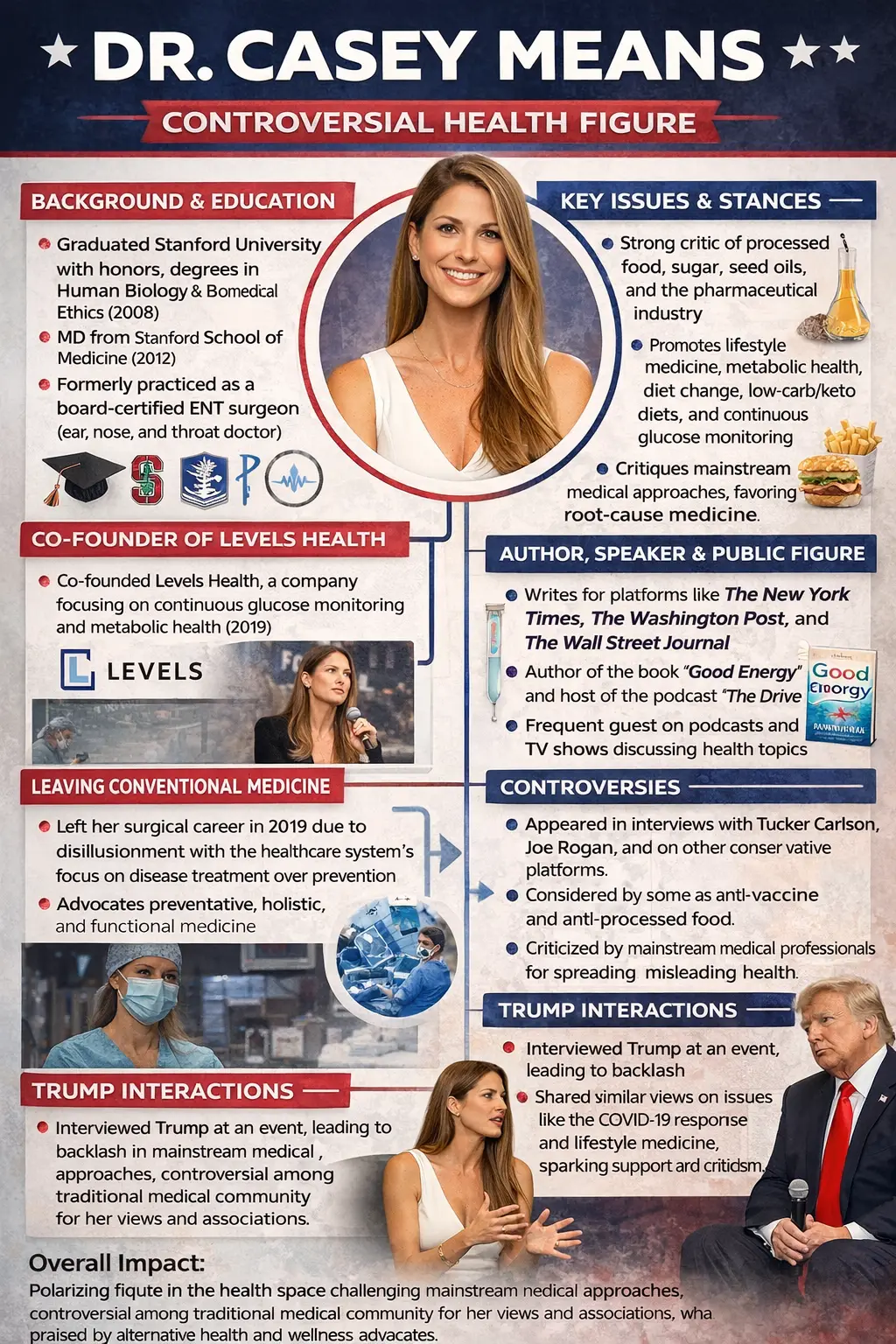

On February 25, 2026, Dr. Casey Means sat before the Senate Health, Education, Labor and Pensions (HELP) Committee to make her case for becoming the next Surgeon General of the United States. The hearing — delayed by five months after she unexpectedly went into labor hours before its original October 2025 date — became one of the most revealing and contentious medical confirmation hearings in recent memory.
She faced questions about vaccines, birth control, psychedelic mushrooms, undisclosed financial conflicts of interest, and her inactive medical license. She was praised by MAHA advocates and pilloried by public health experts. She was, in other words, exactly what she’s always been: a mirror held up to America’s deepest arguments about medicine, food, pharma, and the meaning of health itself.
Stanford-trained. License voluntarily inactive. Wellness entrepreneur. Now Trump’s pick for the most powerful medical platform in the United States. Who exactly is Dr. Casey Means — and what does her nomination say about how America thinks about health, medicine, and power?
“She is less qualified professionally than any other surgeon general in history. There’s no question about that.”
— Dr. Georges Benjamin, CEO, American Public Health Association, quoted by NPR“Casey is the perfect choice for Surgeon General precisely because she left the traditional medical system — not in spite of it.”
— Robert F. Kennedy Jr., U.S. Secretary of Health and Human ServicesWho Is Dr. Casey Means? The Full Biography
Paula Casey Means was born on September 24, 1987, making her 38 years old at the time of her confirmation hearing — one of the youngest nominees for the position. She shared her full birth name on a podcast, noting she was named after St. Paul and later dropped “Paula” after graduating from medical school. She is the daughter of Grady Means, who served as an assistant to Vice President Nelson Rockefeller, worked on health and human welfare at the Department of Health, Education, and Welfare, and later became a managing partner at PricewaterhouseCoopers.
Her mother, Gayle Means, died of pancreatic cancer during the COVID-19 pandemic — an event that Means has cited repeatedly as the personal catalyst for her mission. Her brother, Calley Means, is her intellectual partner and co-author; he now serves as an adviser to RFK Jr. at the Department of Health and Human Services.
- Born September 24, 1987 (age 38). Full birth name: Paula Casey Means.
- Undergraduate degree with honors from Stanford University, where she was class president.
- MD from Stanford University School of Medicine, 2014. Published research at NIH, Stanford Medicine, and NYU.
- Started ENT (head & neck surgery) residency at Oregon Health and Science University (OHSU) — left near completion.
- Medical license placed on voluntary inactive status since 2019. No active prescribing rights.
- Co-founded Levels, a metabolic health tech company using continuous glucose monitors.
- Co-authored Good Energy (2024) with Calley Means — a #1 New York Times bestseller.
- Nominated as Surgeon General by President Trump on May 7, 2025, following withdrawal of Janette Nesheiwat’s nomination.
- Gave birth — hours before her original October 2025 confirmation hearing was set to begin.
- Renominated by Trump on January 13, 2026 after her nomination expired per Senate rules on January 3.
A Life in Medicine — and Beyond It
Paula Casey Means born September 24. Father Grady Means works at the intersection of government and healthcare policy.
Graduates with honors from Stanford University, having served as class president — an early indicator of her leadership ambition.
Earns her MD from Stanford University School of Medicine. Publishes early research in head & neck oncology and otolaryngology.
Begins surgical training at Oregon Health and Science University in head & neck surgery. Grows disillusioned with symptom-management medicine.
Drops out of residency near completion. Opens a functional medicine practice in Portland, Oregon. Medical license placed on voluntary inactive status — where it remains today.
Launches Levels, a health tech company using continuous glucose monitors (CGMs) to help users track metabolic health. Becomes its Chief Medical Officer.
Gayle Means dies during the COVID-19 pandemic, galvanizing Casey and Calley’s mission to reform American healthcare incentives.
Co-authored with Calley Means, the book lays out the case for metabolic health as the root of most chronic disease. Published by Avery/Penguin Random House.
President Trump nominates Means after withdrawing Janette Nesheiwat’s nomination. Officially: PN246-10, 119th Congress.
Goes into labor five hours before her scheduled Senate confirmation hearing. Hearing delayed.
Per Senate rules, nomination expires. Trump renominates her 10 days later.
Appears before the Senate HELP Committee. Questioned on vaccines, birth control, medical credentials, and financial conflicts.
The Credentials Debate: Is Casey Means Qualified?
No aspect of the Casey Means story generates more heat than the question of her credentials. The debate is not a simple one, and both sides have legitimate points — which is precisely why it cuts to the heart of what Americans believe the Surgeon General is actually for.
What She Has
Means holds an MD from one of the world’s most competitive medical schools. She published peer-reviewed research in journals including Head & Neck, The Laryngoscope, Metabolism: Clinical and Experimental, and the International Journal of Pediatric Otorhinolaryngology. She held research positions at the NIH, Stanford, and NYU. She served on Stanford faculty. She has been Associate Editor of the International Journal of Disease Reversal and Prevention.
What She Lacks — and Her Response
Means does not hold an active medical license. She is not board-certified in any specialty. She did not complete her residency. She has not seen patients since approximately 2019. At her confirmation hearing, she stated clearly that she has no plans to reactivate her license: “I do not plan to reactivate, because I’m not going to be seeing patients in this role.”
Sen. Andy Kim (D-NJ) pressed Means directly: would she reactivate her Oregon medical license if confirmed? Her answer: no. She characterized her inactive status as voluntary, clarifying she placed her license on inactive status “because I’m not actively seeing patients.” She called media coverage of the license issue a source of “severe misinformation.” Critics note that the distinction between “inactive” and “lapsed” is real but that the practical result — an inability to prescribe medications — is the same.
How Means Compares to Recent Surgeons General
| Name | Active License | Board Certified | Completed Residency | Clinical Practice |
|---|---|---|---|---|
| Vivek Murthy (2021–25) | ✓ | ✓ | ✓ | ✓ |
| Jerome Adams (2017–21) | ✓ | ✓ | ✓ | ✓ |
| Vivek Murthy (2014–17) | ✓ | ✓ | ✓ | ✓ |
| Casey Means (Nominee) | ✗ Inactive | ✗ | ✗ Left early | ✗ Since 2019 |
Why Supporters Say She’s Right for the Job
Supporters, led by RFK Jr., argue that the Surgeon General is primarily a public communicator and educator, not a clinical practitioner. The role involves issuing advisory reports, leading the U.S. Public Health Service Commissioned Corps (~6,000 officers), and shaping the national health conversation. Means’s supporters contend that her mass-media reach, best-selling book, and populist following make her uniquely suited to the communicator-in-chief aspect of the role. “She’s the perfect choice precisely because she left the system,” Kennedy has said, framing her departure from surgery as evidence of principled integrity rather than a disqualifying failure.
Her academic pedigree is also not trivial: an MD from Stanford is among the most rigorous medical educations in the world, and she published peer-reviewed science during her training years.
Dr. Casey Means:
America’s Most Controversial
Doctor-in-Waiting
Why Critics Say She Falls Short
American Public Health Association CEO Dr. Georges Benjamin told NPR she is “less qualified professionally than any other surgeon general in history.” The criticism rests on several pillars: she lacks an active license, has not practiced medicine in years, is not board-certified, holds financial interests in health-related companies she promotes, and has made public statements that conflict with mainstream public health positions on vaccines and birth control. Democratic senators at the February 25 hearing, including Sen. Chris Murphy (D-CT) and Sen. Bernie Sanders (I-VT), pressed hard on what they characterized as undisclosed conflicts of interest — sponsorships for dietary supplements she promoted without disclosing her financial relationship.
What the Surgeon General Actually Does
The U.S. Surgeon General is the operational head of the United States Public Health Service (USPHS) Commissioned Corps, a uniformed service of more than 6,000 health professionals working across federal agencies. The SG issues Surgeon General’s Reports — landmark public health documents (the 1964 report on smoking is the most famous) that shape policy and public understanding. The SG also issues public health advisories, represents the nation’s health interests in the media, and advises the President and HHS Secretary. Crucially: the role does not involve seeing patients. The clinical license argument is therefore partly about symbolism and authority — can someone without a license credibly serve as “America’s Doctor”?
The February 25, 2026 Confirmation Hearing: Everything That Happened
The hearing, broadcast live on C-SPAN and covered wall-to-wall by major outlets, was the first Senate confirmation hearing to be held virtually in this format — though Means ultimately appeared in person. Senators from both parties used the session to surface concerns that had been building since her May 2025 nomination.
The committee’s Republican chair, Sen. Bill Cassidy (R-LA) — himself a physician — asked Means whether she accepts the scientific evidence that vaccines do not cause autism. Her answer: “I do accept that evidence. I also think that science has never settled.” Sen. Bernie Sanders called the reply “political and not to the point,” noting that the American Medical Association says studies showing no vaccine-autism link are overwhelming. Means acknowledged that “vaccines save lives” but declined to directly encourage parents to vaccinate against measles and flu — a position that alarmed public health advocates, particularly given that measles cases hit a three-decade high in 2025 amid falling vaccination rates.
Means has previously said widespread contraception use reflects that “we have lost respect for life” — a statement she made on Tucker Carlson’s program in August 2024. At the hearing, she attempted to reframe these comments, saying she supports access to oral contraception but believes many prescriptions occur without adequate informed consent given patients’ medical histories. Critics, including Center for Science in the Public Interest president Peter Lurie, said her revised answers differed substantially from her past statements.
Sen. Susan Collins (R-ME) raised a passage in Means’s book Good Energy in which she describes using psychedelic mushrooms therapeutically in 2021. Collins expressed concern and asked whether Means would recommend such substances to the American public. Means said she would not — and that her personal experience was in a therapeutic context.
Sen. Chris Murphy (D-CT) pressed Means on what he characterized as a pattern of promoting health products on social media while concealing financial relationships with those companies — a potential violation of FTC disclosure rules. He cited a specific example: Means allegedly receiving partnership fees for a prenatal vitamin brand while posting on social media that she was simply a “fan.” Means denied the assertion: “It’s incorrect and it’s a false representation.” She said she had worked with the Office of Government Ethics to ensure full compliance. Politico had previously reported that Means’s Senate submission of financial disclosure and ethics paperwork caused delays — as of July 2025, her nomination was stalled pending that paperwork.
Pressed by Sen. Andy Kim (D-NJ), Means confirmed she has no plans to reactivate her Oregon medical license. She framed it as a voluntary choice tied to not seeing patients — and said media coverage characterizing her as unlicensed was “severe misinformation.” Technically, the license exists but is on inactive status, meaning she cannot prescribe medications. Whether a Surgeon General needs an active clinical license has no statutory requirement — but no previous SG has served without one.
* Bars are illustrative based on reporting, not a single poll. Compiled from NPR, STAT News, CBS News coverage.
Good Energy: The Book That Started It All
Published in May 2024 by Avery/Penguin Random House, Good Energy: The Surprising Connection Between Metabolism and Limitless Health became a #1 New York Times bestseller and the intellectual backbone of the Casey Means public persona. Co-written with her brother Calley, it is simultaneously a memoir, a metabolic science primer, and a policy argument — and has been read across the ideological spectrum.
The book’s central thesis: metabolic dysfunction is the root cause of most chronic disease in America — not individual diagnoses treated in isolation. Poor mitochondrial function, driven by ultra-processed food, sedentary lifestyle, disrupted sleep, and chronic stress, creates a cascade of “bad energy” that expresses itself as obesity, type 2 diabetes, cancer, Alzheimer’s, heart disease, and depression. The solution, she argues, is treating the cellular root rather than the symptomatic branch.
“Almost all of the top-ten causes of death in the United States are connected by a common root cause: metabolic dysfunction at the cellular level.”
— Casey Means, Good Energy (2024)The book draws on her own experience as a surgical resident watching patient after patient receive steroids, surgery, or prescriptions for conditions that might have responded to dietary and lifestyle change. Her pivotal anecdote: recognizing while doing ENT surgery that she was an “inflammation physician” treating the symptoms of systemic metabolic dysfunction while the underlying cause went unaddressed.
Critics have noted the book’s framework leans on her association with Levels, the glucose-tracking company she co-founded — whose devices and app are central to the book’s recommendations. Some reviewers flagged that the Levels CGM subscription costs approximately $500 upfront plus $250 per month — making the “personalized” health approach the book advocates expensive and inaccessible for many Americans. Science journalist Jonathan Jarry of the McGill Office for Science and Society wrote that Means “is not a metabolic health expert” and that “theories claiming to have found a single cause for all diseases never pan out.”
The Bigger Picture: History, Philosophy & What This Moment Means
A Historical Inflection Point
The role of Surgeon General has a complex history. Created formally in 1871, the office gained its greatest influence under Dr. C. Everett Koop, whose 1986 report on AIDS and unflinching public health advocacy made the position a genuine bully pulpit. The landmark 1964 Surgeon General’s Report on Smoking — perhaps the most consequential public health document in American history — demonstrated how a single report from that office can reshape an entire society’s behavior over decades.
What made those moments work was the combination of institutional credibility and communicative courage. Casey Means, her supporters argue, brings the second quality in abundance. Her critics contend she lacks the first. The question is whether, in 2026, credibility with the public health establishment and credibility with the 60% of Americans who live with at least one chronic condition have become the same thing.
The MAHA Movement in Historical Context
The Make America Healthy Again (MAHA) movement, championed by RFK Jr. and the Means siblings, fits within a long American tradition of anti-establishment health populism — from 19th-century hydrotherapy movements to 1970s health food counterculture to today’s functional medicine and wellness economy, now worth over $5.6 trillion globally according to the Global Wellness Institute. What’s historically novel is that this movement has, for the first time, gained explicit executive branch sponsorship.
Philosophically, Means occupies a position that is neither straightforwardly progressive nor conservative. She draws on Ivan Illich’s Medical Nemesis (1975) — the argument that modern medicine has become counterproductive, creating more disease than it cures through iatrogenesis — without citing him. She articulates a critique of financialized medicine that would feel at home in a progressive policy journal, while simultaneously championing personal responsibility narratives more common on the right. This cross-cutting quality is both her political strength and the source of her ideological critics on all sides.
Statistical Reality: America’s Chronic Disease Crisis
Whatever one thinks of Means’s qualifications or methods, the underlying problem she describes is real and alarming:
- 60% of American adults live with at least one chronic condition (CDC)
- 42% of American adults are obese (CDC, 2020 data)
- 88% of Americans show at least one marker of metabolic dysfunction (University of North Carolina, 2018)
- $4.5 trillion — annual U.S. healthcare spending, over 90% on chronic disease treatment (CMS)
- Type 2 diabetes affects 37 million Americans and is projected to affect 1 in 3 by 2050 (American Diabetes Association)
These numbers form the empirical foundation of Means’s argument. Where she diverges from mainstream public health is not in diagnosing the problem but in prescribing the solution — and, crucially, in assigning blame. Her framing of Big Food and Big Pharma as actively profiting from illness resonates deeply with Americans who have watched healthcare costs consume an ever-larger share of their wages and whose chronic conditions have been managed rather than reversed.
You scored X / 6
The Bottom Line: What Happens Next
As of February 26, 2026, Casey Means’s confirmation remains pending before the Senate HELP Committee, chaired by Sen. Bill Cassidy (R-LA). The committee must vote to advance her nomination before the full Senate can confirm her. Her path to confirmation is complicated by skepticism from both parties: Democrats focus on credentials and conflicts, while some Republicans worry about her positions on vaccines and her lack of the anti-vax credentials preferred by portions of the MAHA base.
The broader significance of the Means nomination extends beyond one appointment. It represents a genuine ideological contest over what the United States believes medicine is for. If confirmed, she would be the most unconventional Surgeon General in the office’s 150-year history — a wellness influencer and entrepreneur in a post that was once the domain of career public health officials. Whether that is a problem or a feature depends entirely on who is answering the question.
What is certain: the chronic disease crisis Means diagnoses is real. The American healthcare system’s failures are documented and measurable. And the debate her nomination has sparked — about credentials, about conflicts, about the meaning of evidence, and about who gets to be called “America’s Doctor” — is a debate this country desperately needs to have.