
The geopolitical landscape of the Middle East was fundamentally restructured on February 28, 2026, following the successful execution of a high-precision joint military operation by the United States and Israel that resulted in the death of Ayatollah Ali Khamenei.1 This event, terminating the thirty-seven-year reign of the second Supreme Leader of the Islamic Republic of Iran, has triggered an immediate constitutional crisis, widespread regional military escalation, and profound uncertainty regarding the future of theocratic rule in Persia.3 The operation, designated Operation Epic Fury by United States Central Command and Operation Roaring Lion by the Israel Defense Forces (IDF), represents the most significant decapitation of a state leadership apparatus in the twenty-first century.5 This report provides an exhaustive analysis of the military engagement, the subsequent internal power struggle within the Iranian regime, the regional retaliatory strikes, and the broader socio-economic implications for global stability.
Strategic Execution of Operation Epic Fury
The military campaign initiated in the early hours of February 28, 2026, was characterized by a scale and technological sophistication that overwhelmed the integrated air defense systems of the Islamic Republic.3 According to senior defense officials, the combined US-Israeli force conducted nearly 900 strikes against high-value Iranian targets within the first twelve hours of the campaign.3 The primary objectives of this initial phase were the systematic suppression of Iranian air defenses (SEAD), the degradation of long-range retaliatory missile capabilities, and the total disruption of the regime’s command-and-control (C2) infrastructure.3
The strike that neutralized Ayatollah Ali Khamenei targeted his residence and official compound in the “heart of Tehran”.5 Satellite imagery and local reports confirmed that the compound was severely damaged, with several primary structures completely leveled.7 While initial claims from Iranian state media and Foreign Minister Abbas Araghchi suggested that the leadership remained alive, the subsequent confirmation of the death of the 86-year-old leader by Iranian state television and the Supreme National Security Council late on Saturday night settled the immediate question of his status.2 The precision of the strike was such that it reportedly also eliminated five to ten other senior members of the clerical and military establishment who were present for an emergency session.5
| Operational Metric | Operation Epic Fury / Roaring Lion (2026) | June 2025 Airstrikes (Comparative) |
| Total Strikes (First 12 Hours) | ~900 | ~350 |
| Provinces Targeted | 17 | 9 |
| Confirmed Leadership Casualties | Ali Khamenei, Abdolrahim Mousavi, 40+ Senior Officials | Iranian Nuclear Scientists, IRGC Middle Management |
| Primary Target Focus | Command-and-Control, Central Leadership | Nuclear Enrichment Infrastructure |
| Air Superiority Status | Rapidly Established within 2 Hours | Contested for 48 Hours |
The effectiveness of the SEAD mission was unprecedented. The IDF reportedly neutralized at least eleven advanced air defense batteries in western Iran, including an SA-65 system at the 29th Nabi Akram Operational Division base in Kermanshah Province.3 Radar installations on Kish Island were also destroyed, effectively blinding the regime’s maritime surveillance capabilities in the Persian Gulf.3 By the time the second wave of strikes hit the Khomein Missile Base in Markazi Province—a facility previously targeted in 2025—the Iranian Air Force and its ground-based defenses were largely non-functional.3 This allowed the allied forces to maintain air superiority over Tehran and other major cities throughout the weekend.3
The Constitutional Interregnum and the Interim Leadership Council
The sudden death of the Supreme Leader, who held ultimate authority over all political, military, and religious spheres in Iran, triggered the immediate activation of Article 111 of the Constitution of the Islamic Republic.8 This constitutional mechanism requires that in the event of the death or incapacity of the Supreme Leader, a provisional leadership council must be formed to exercise his duties until a permanent successor is elected by the Assembly of Experts.9
On March 1, 2026, the Expediency Discernment Council confirmed the formation of a three-member interim body.10 This council is designed to represent the three primary pillars of the Iranian state: the executive, the judiciary, and the clerical establishment.11 The composition of this council is critical for maintaining internal stability as the regime faces both external military pressure and internal civil unrest.13
| Council Member | Role in Interim Council | Primary Institutional Base |
| Masoud Pezeshkian | President of the Republic | Executive Branch / State Bureaucracy |
| Gholam-Hossein Mohseni-Ejei | Chief Justice of Iran | Judiciary / Intelligence Apparatus |
| Ayatollah Alireza Arafi | Cleric of the Guardian Council | Clerical Establishment / Qom Seminaries |
The inclusion of Masoud Pezeshkian is viewed by some as an attempt to maintain a facade of moderate governance, though his actual influence within the security-dominated council is believed to be minimal.15 Chief Justice Mohseni-Ejei, a long-time security insider, ensures that the judicial and repressive mechanisms of the state remain focused on internal security.11 However, the most significant appointment to this body is Ayatollah Alireza Arafi, who fills the clerical seat mandated by the constitution.11
The Rise of Alireza Arafi
Ayatollah Alireza Arafi has emerged as the pivotal clerical figure in the transition process. Born in 1959 in Meybod, Yazd province, Arafi is a product of the prestigious Qom theological seminaries and a long-time confidant of the late Ali Khamenei.12 His career has been defined by his steady ascent through the institutional hierarchy rather than popular politics. Notably, Arafi failed to win an election to the Assembly of Experts in 2016 but was later appointed to the Guardian Council by Khamenei in 2019, a move that signaled deep trust from the Supreme Leader.12
Arafi’s ideological profile is that of a “revolutionary” but “modernizing” cleric. He has previously served as the president of Al-Mustafa International University, an institution dedicated to exporting the ideology of the Islamic Republic and training foreign Shia clerics.12 During his tenure, he claimed to have facilitated the conversion of millions to Shia Islam and has notably advocated for the use of artificial intelligence in religious and state governance.12 His role in the interim council is to bridge the gap between traditional religious authority and the modern bureaucratic needs of a state in crisis.13
The Succession Struggle: Contenders for the Third Supreme Leader
The Assembly of Experts, an 88-member body of senior clerics, is now under immense pressure to select a permanent successor to Ali Khamenei.8 This selection process, which is historically confidential, is now complicated by the fact that the transition is occurring during an active war.14 The choice of the next Supreme Leader will determine whether the Islamic Republic survives as a theocracy, pivots toward a more military-dominated junta, or collapses under the weight of its own internal contradictions.9
Mojtaba Khamenei and the Dynastic Question
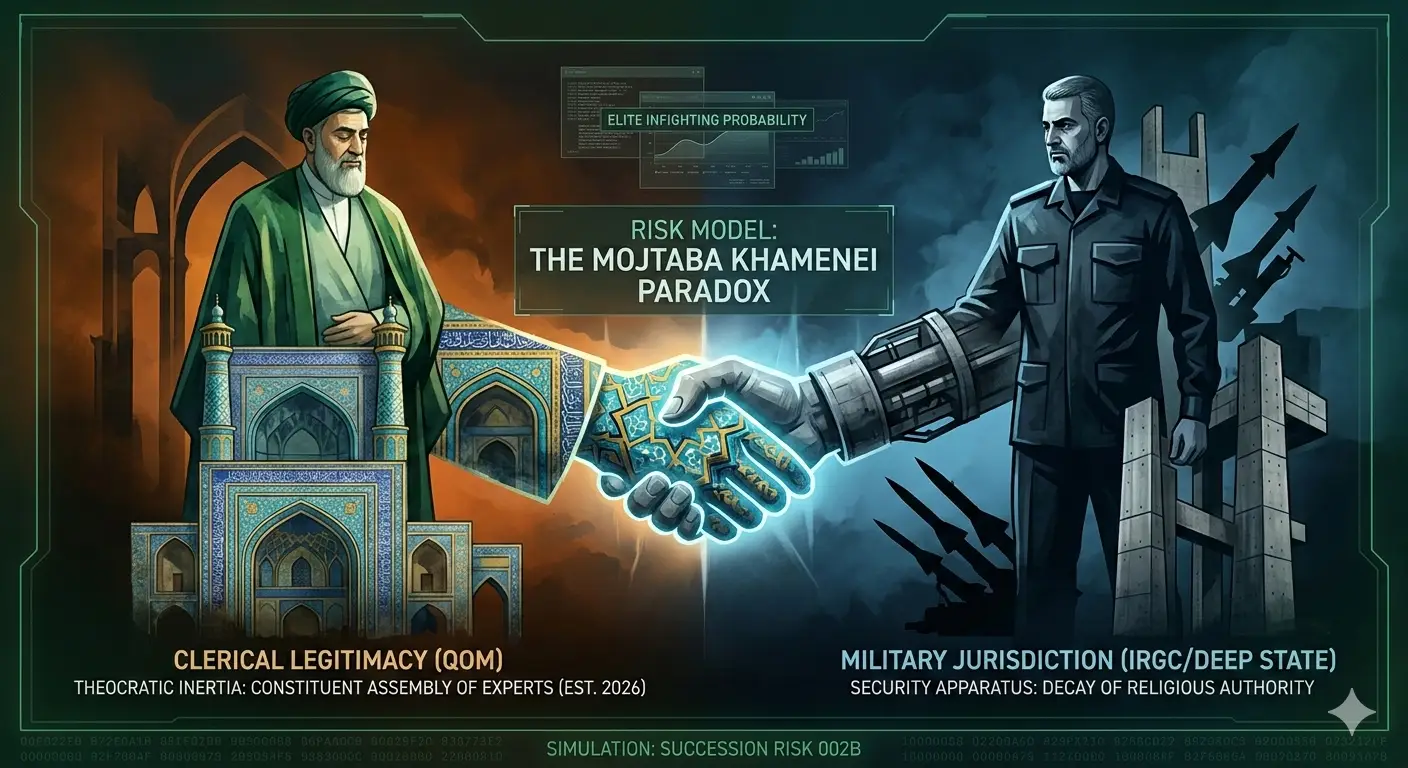
The most prominent and controversial candidate is Mojtaba Khamenei, the 56-year-old second son of the late Supreme Leader.10 Mojtaba is believed to wield significant influence behind the scenes, particularly within the Office of the Supreme Leader and the intelligence services.10 His close ties to the Islamic Revolutionary Guard Corps (IRGC) make him the preferred candidate for those who favor a security-first approach to governance.10
However, Mojtaba faces substantial obstacles. The 1979 Revolution was explicitly anti-monarchical, and the prospect of hereditary succession is viewed with suspicion by many senior clerics and the broader public.10 Furthermore, while he has recently been referred to as an “Ayatollah” in state-affiliated media to bolster his religious credentials, his clerical standing is still considered inferior to other potential candidates.10 His appointment could trigger a rift between the clerical establishment in Qom and the IRGC leadership in Tehran.9
Alternative Candidates and Power Blocs
Beyond Mojtaba Khamenei and Alireza Arafi, several other figures are being assessed by analysts:
- Ali Larijani: The former Speaker of the Parliament and currently the head of the Supreme National Security Council. Larijani is seen as a pragmatic conservative who could potentially navigate a de-escalation with the West, though his standing with hardline factions is tenuous.3
- Mohammad Bagher Ghalibaf: The current Speaker of the Parliament and a former IRGC commander. He represents the “technocratic” wing of the hardliners but lacks the clerical rank necessary to become Supreme Leader under the current constitution.3
- Hassan Khomeini: The grandson of Ruhollah Khomeini. While he carries the most prestigious name in the Republic, he is largely marginalized by the current hardline establishment and is viewed as too moderate for the present crisis.9
- Hashem Hosseini Bushehri: A senior member of the Assembly of Experts who represents the traditional Qom clerical elite. He could emerge as a consensus candidate if the Assembly seeks to avoid a radical shift toward either Mojtaba Khamenei or a more military-focused leader.9
Regional Retaliation: The “Axis of Resistance” Strikes Back
The response from the Iranian military and its regional proxies was swift but asymmetric. Within hours of the strike on Tehran, the IRGC announced that it would launch its “most-intense offensive operation” in history.5 This retaliation has expanded the theater of war beyond the borders of Iran, targeting US military installations and the economic infrastructure of allied Gulf states.22
Attacks on the Persian Gulf Hubs: Dubai and Bahrain
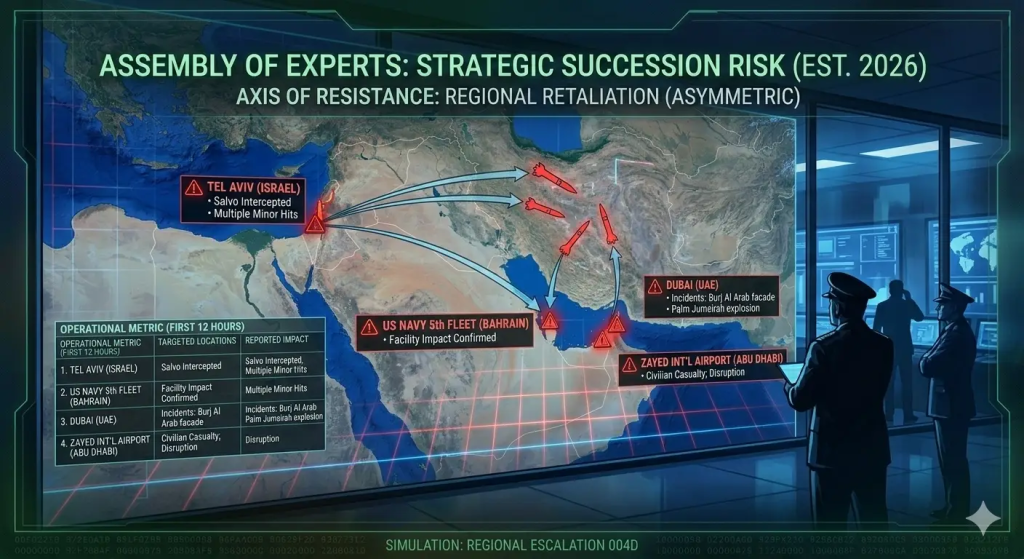
In a significant escalation, Iranian drones and missiles targeted the United Arab Emirates and Bahrain.22 Bahraini officials confirmed that a missile attack targeted the headquarters of the US Navy’s Fifth Fleet, although the full extent of the damage has not been disclosed.22 This strike on a sovereign Arab state hosting US forces represents a direct challenge to regional security architectures.
In Dubai, the city-state was rocked by reports of explosions and drone sightings.23 While initial social media reports suggested that the Burj Khalifa and Dubai Mall had been struck, these were later refined by official sources.23 The Dubai Media Office confirmed that a drone was intercepted over the city, and debris from the interception caused a minor fire on the outer facade of the Burj Al Arab hotel.23 Additionally, a confirmed explosion and fire occurred at the Palm Jumeirah, resulting in at least four injuries.24
| Target Location | Incident Type | Reported Impact / Casualties |
| US Navy 5th Fleet (Bahrain) | Missile Strike | Impact confirmed; damage assessment ongoing |
| Burj Al Arab (Dubai) | Drone Debris / Fire | Minor facade damage; no injuries |
| Palm Jumeirah (Dubai) | Explosion / Fire | 4 injuries confirmed; fire controlled |
| Zayed Int’l Airport (Abu Dhabi) | Missile/Drone Incident | 1 death (Asian national); 7 injuries |
| Tel Aviv Area (Israel) | Missile Salvo | 21 injuries; 1 person in critical condition |
The targeting of Abu Dhabi’s Zayed International Airport resulted in the first confirmed civilian death outside of the primary combat zones—an Asian national who was killed during an “incident” at the facility.23 These strikes are clearly intended to punish the Gulf states for their perceived cooperation with the US-Israeli operation and to destabilize the global energy and travel markets.24
Retaliation Against Israel and US Bases
Iran also launched a large-scale missile salvo toward Israel, with reports of twenty-one people injured in the Tel Aviv area.23 The IDF reported that its sophisticated air defense systems intercepted the majority of the incoming threats, but physical damage was noted in several parts of the city.6 Furthermore, US bases in Qatar, Kuwait, and Iraq were targeted by drone swarms launched by the Islamic Resistance of Iraq, an umbrella group of Iranian-backed militias.3
Domestic Turmoil: The Human Cost and Internal Dissent
Inside Iran, the news of Khamenei’s death has produced a volatile mixture of state-mandated mourning and spontaneous celebration.15 While state media broadcast images of thousands of mourners gathering at the University of Tehran for the funeral, independent reports and social media videos showed residents in cities like Karaj and Tehran cheering, whistling, and setting off fireworks to celebrate the end of the Supreme Leader’s rule.15
The January Protests and the Legacy of Repression
The current crisis is unfolding against the backdrop of the “January Massacres” of 2026. Following a wave of nationwide protests against the clerical regime earlier in the year, the security forces engaged in a brutal crackdown that resulted in the deaths of an estimated 30,000 protesters.1 This unprecedented level of domestic violence has left the population deeply traumatized and radicalized.16 Activists like Masih Alinejad have described the killing of Khamenei as a “new world” for Iranians who have spent decades under the “law of the jungle” enforced by the IRGC.4
The Minab School Strike and Civilian Casualties
The ongoing military campaign has not been without civilian cost. Iranian state television reported a devastating strike on a girls’ elementary school in Minab County, Hormozgan Province.23 According to provincial officials, at least 51 students were killed and 60 wounded when a missile struck the facility during the Saturday morning strikes.23 While the Israeli military has stated it has no information regarding such a strike and emphasized that its operations are “extremely accurate,” US Central Command has opened a review into the reports of civilian harm.5 The images of the school strike shared by Iranian officials have become a central element of the regime’s wartime propaganda, aimed at galvanizing domestic support and condemning the “American-Zionist axis”.15
International Realignment and Global Reactions
The assassination of a sovereign head of state has elicited a fractured response from the international community. US President Donald Trump, in a series of videos posted to Truth Social, confirmed that the United States is engaged in “major combat operations” and urged the Iranian people to “take back their country”.1 He characterized the strikes as a “noble mission” to prevent a “vicious group of hard, terrible people” from acquiring nuclear weapons.5
The Russo-Chinese Response
In contrast, Russia and China have condemned the operation in the strongest possible terms. President Vladimir Putin expressed his condolences to President Masoud Pezeshkian, calling the assassination a “cynical violation of all norms of human morality and international law”.26 China’s Foreign Minister Wang Yi echoed these sentiments, stating that the “blatant killing of the leader of a sovereign state” is unacceptable and undermines the foundations of global peace.4 These reactions suggest that the conflict could solidify a counter-Western bloc, further complicating diplomatic efforts to de-escalate the situation.
United Nations and Global Security
The United Nations Security Council convened an emergency session where Secretary-General António Guterres warned that the world is “at the brink” of a wider conflict.23 While he condemned the Iranian retaliatory strikes for violating the sovereignty of neighboring states, he also noted that the US-Israeli airstrikes violated international law and the UN Charter.23 The UN’s primary concern remains the potential for a total regional war that could disrupt one-third of the world’s oil supply, which is shipped through the Strait of Hormuz.8
Economic and Demographic Impact of the Conflict
The war has had an immediate and deleterious effect on global markets. Oil prices surged following the reports of strikes in Iran and the subsequent retaliation against Gulf economic hubs.1 Major international airlines, including Air India and IndiGo, cancelled flights to the region, and the Indian government issued an advisory for its citizens in Iran to remain indoors.18
| Demographic Data: Islamic Republic of Iran (2026 Estimates) | Value |
| Total Population | 93,168,497 |
| Annual Growth Rate | 0.81% |
| Median Age | 34.5 Years |
| Urban Population Percentage | 73.5% |
| Population of Tehran (Metro Area) | ~9.8 Million |
| Total Fertility Rate (TFR) | 1.66 |
The demographic profile of Iran presents a complex challenge for the regime. With a population of over 93 million and a median age of 34.5 years, the majority of Iranians have known no leader other than Ali Khamenei.31 The high urbanization rate (73.5%) means that the regime is particularly vulnerable to civil unrest in major cities, where information blackouts—such as the near-total internet shutdown implemented on February 28—are increasingly difficult to maintain.3 The economic pressure of the war, combined with the long-standing deterioration of the Iranian Rial and the high youth unemployment rate (20.2%), creates a volatile environment that could lead to a systemic collapse if the succession process is not handled with extreme care.1
Conclusion: The Horizon of Geopolitical Uncertainty
The assassination of Ayatollah Ali Khamenei on February 28, 2026, marks the end of a theological era and the beginning of a period of profound geopolitical instability. Operation Epic Fury has achieved its immediate tactical goal of decapitating the Iranian leadership, but it has simultaneously unleashed a wave of regional retaliation and internal chaos that may take years to resolve.5 The formation of the Interim Leadership Council under Alireza Arafi represents a desperate attempt by the clerical establishment to maintain control, but the looming shadow of Mojtaba Khamenei and the potential for a military takeover by the IRGC suggest that the path forward will be marked by intense elite infighting.10
For the international community, the risks are manifold. The threat to global energy security via the Strait of Hormuz, the potential for a multi-front war involving US and Israeli forces, and the risk of a complete humanitarian collapse within Iran are all imminent concerns.8 As the 88-member Assembly of Experts prepares to elect the third Supreme Leader of the Islamic Republic, the world watches to see if the system founded by Ruhollah Khomeini in 1979 can survive the most significant crisis in its nearly fifty-year history.1 The coming days will determine whether this conflict remains a contained military operation or escalates into a global catastrophe.
Works cited
- Ayatollah Ali Khamenei obituary – The Guardian, accessed March 1, 2026, https://www.theguardian.com/world/2026/mar/01/ayatollah-ali-khameini-obituary
- Iran’s supreme leader killed in U.S.-Israeli attack; Tehran strikes Israel, Arab states, accessed March 1, 2026, https://www.washingtonpost.com/world/2026/02/28/israel-strikes-iran-live-updates/
- Iran Update Evening Special Report, February 28, 2026 | ISW, accessed March 1, 2026, https://understandingwar.org/research/middle-east/iran-update-evening-special-report-february-28-2026/
- The Latest: Israel hits Tehran as Iran’s counterattacks widen after the supreme leader was killed, accessed March 1, 2026, https://www.ksat.com/news/world/2026/03/01/the-latest-irans-supreme-leader-khamenei-killed-in-us-israeli-attack/
- Supreme Leader of Iran Khamenei dead following Israel’s strike on Iran – Fox News, accessed March 1, 2026, https://www.foxnews.com/live-news/israel-us-launch-attack-on-iran-amid-escalating-protests
- More strikes aimed at Iran after Khamenei’s death, accessed March 1, 2026, https://www.polskieradio.pl/395/7785/Artykul/3654263,more-strikes-aimed-at-iran-after-khameneis-death
- Israeli TV report, citing unnamed Israeli sources: Growing indications that Khamenei killed, accessed March 1, 2026, https://www.timesofisrael.com/liveblog_entry/israeli-tv-report-citing-unnamed-israeli-sources-growing-indications-that-khamenei-killed/
- US-Iran update: What happens after Ali Khamenei’s death? Chaos …, accessed March 1, 2026, https://www.hindustantimes.com/world-news/us-news/usiran-update-what-happens-after-ali-khameneis-death-chaos-election-and-new-supreme-leader-101772310074947.html
- 2026 Iranian Supreme Leader election – Wikipedia, accessed March 1, 2026, https://en.wikipedia.org/wiki/2026_Iranian_Supreme_Leader_election
- Mojtaba Khamenei, son of Ayatollah Ali Khamenei: Could he be Iran’s next supreme leader?, accessed March 1, 2026, https://m.economictimes.com/news/new-updates/mojtaba-khamenei-son-of-ayatollah-ali-khamenei-could-he-be-irans-next-supreme-leader/articleshow/128909519.cms
- Who Is Ayatollah Alireza Arafi? Iran’s Interim Supreme Leader After Ali Khamenei’s Death, accessed March 1, 2026, https://www.ndtvprofit.com/world/who-is-ayatollah-alireza-arafi-irans-interim-supreme-leader-after-ali-khameneis-death-11154133
- Ayatollah Alireza Arafi is Iran’s interim leader 10 yrs after poll loss: How he rose to likely succeed Khamenei, accessed March 1, 2026, https://www.hindustantimes.com/world-news/10-yrs-after-election-loss-alireza-arafi-is-irans-interim-leader-how-he-rose-to-likely-succeed-ayatollah-khamenei-101772366147176.html
- Who is Ayatollah Alireza Arafi? Iran’s interim Supreme Leader after Khamenei’s death, accessed March 1, 2026, https://timesofindia.indiatimes.com/world/middle-east/who-is-ayatollah-alireza-arafi-irans-interim-supreme-leader-after-khameneis-death/articleshow/128912892.cms
- After Khamenei: Who – or What – Replaces him?, accessed March 1, 2026, https://alhurra.com/en/14637
- Live updates: U.S. military confirms 3 troops killed as Iran lashes out …, accessed March 1, 2026, https://www.cbsnews.com/live-updates/us-iran-war-israel-supreme-leader-khamenei-funeral-day-2/
- Iran bloodshed to worsen without world reaction, activist tells UN, accessed March 1, 2026, https://www.iranintl.com/en/202601151768
- Alireza Arafi – Wikipedia, accessed March 1, 2026, https://en.wikipedia.org/wiki/Alireza_Arafi
- Who is Ayatollah Alireza Arafi? ‘Revolutionary’ Shiite cleric appointed as Iran’s Interim Supreme Leader, accessed March 1, 2026, https://m.economictimes.com/news/new-updates/who-is-ayatollah-alireza-arafi-revolutionary-shiite-appointed-as-irans-interim-supreme-leader-after-khameneis-death/articleshow/128913501.cms
- Who could replace Khamenei under Iran’s succession process?, accessed March 1, 2026, https://www.thenationalnews.com/news/mena/2026/03/01/how-succession-works-in-iran-and-who-could-replace-khamenei/
- After Khamenei, who leads Iran and what’s next? The country enters a critical transition, accessed March 1, 2026, https://gulfnews.com/world/mena/after-khamenei-who-leads-iran-and-what-s-next-the-country-enters-a-critical-transition-1.500459584
- Iran’s Supreme Leader Is Dead. Who Will Succeed Him? It’s Complicated., accessed March 1, 2026, https://www.rferl.org/a/iran-succession-khamenei-killed-succession/33691251.html
- Bahrain says US Navy’s 5th Fleet headquarters hit in ‘missile attack’, accessed March 1, 2026, https://m.economictimes.com/news/defence/iran-israel-war-bahrain-says-us-navys-5th-fleet-headquarters-hit-in-missile-attack/articleshow/128880732.cms
- Iran-Israel conflict updates: Iran Guards say targeted Israeli bases …, accessed March 1, 2026, https://www.thehindu.com/news/international/iran-israel-usa-conflict-strikes-attack-west-asia-us-trump-live-updates-february-28-2026/article70687247.ece
- Was Burj Khalifa and Dubai mall attacked by Iranian drones, and which places have been hit in airstrikes on UAE till now? Dubai Bombing and Iran Dubai conflict explained – The Economic Times, accessed March 1, 2026, https://m.economictimes.com/news/international/us/was-burj-khalifa-and-dubai-mall-attacked-by-iranian-drones-and-which-places-have-been-hit-in-airstrikes-on-uae-till-now-dubai-bombing-and-iran-dubai-conflict-explained/articleshow/128895916.cms
- OIC summit on Palestine reject US decision on Jerusalem – Hürriyet Daily News, accessed March 1, 2026, https://www.hurriyetdailynews.com/oic-summit-on-palestine-reject-us-decision-on-jerusalem-132044
- Putin condemns US-Israeli strikes on Iran, calls Khamenei’s killing ‘cynical murder’, accessed March 1, 2026, https://www.livemint.com/news/world/putin-condemns-us-israeli-strikes-on-iran-calls-khamenei-s-killing-cynical-murder-11772371092021.html
- Iran’s supreme leader Khamenei killed in US-Israeli strike, accessed March 1, 2026, https://www.awazthevoice.in/world-news/iran-s-supreme-leader-khamenei-killed-in-us-israeli-strike-53057.html
- Finally, you’re gone: Iran-origin activist reacts to reports of Khamenei’s death, accessed March 1, 2026, https://www.indiatoday.in/world/story/us-israel-strikes-iran-masih-alinejad-reaction-to-reports-of-khamenei-death-2876053-2026-03-01
- Condolences over the assassination of Supreme Leader of Iran Ali Khamenei, accessed March 1, 2026, http://en.kremlin.ru/events/president/news/79238
- https://www.hindustantimes.com/sitemap/news.xml, accessed March 1, 2026, https://www.hindustantimes.com/sitemap/news.xml
- Iran Demographics 2026 (Population, Age, Sex, Trends) – Worldometer, accessed March 1, 2026, https://www.worldometers.info/demographics/iran-demographics/
- Iran Population (2026) – Worldometer, accessed March 1, 2026, https://www.worldometers.info/world-population/iran-population/
- Iran Population 2026, accessed March 1, 2026, https://worldpopulationreview.com/countries/iran
- Iran Population – Trading Economics, accessed March 1, 2026, https://tradingeconomics.com/iran/population